Scouting is over 100 years old! 2007 was the Centenary of World Scouting, while 2008 was the Centenary of Scouting in Australia (and the year Rosanna Cubs turned 1)! Cub Scouts started in 1916, so 2006 was the 90th Anniversary. Here's a bit of history of Scouting (covering Cub Scouts) for you:
Scouting - where it all came from
The History of Cubbing
The Jungle Book - A Theme for Cubbing
Stars in their Eyes - Wolf Cubbing moves on
Rosanna Cubs - Recent History
Bibliography

The Founder of Scouting, Lord Baden-Powell of Gilwell, was born in England in 1857. He lived a busy and adventurous life and, as a boy, spent much of his spare time in open-air pursuits, hunting in the woods, and joining his brothers in expeditions by land and in their boats. Thus he developed his powers of observation and resourcefulness, which helped him to acquire many useful skills.
His family was not wealthy, his father having died when Baden-Powell was young. His only chance for higher education was to obtain a scholarship. This gave him entry into the Army. He was sent to India, where he served for many years. He tried out his ideas of training soldiers in "scouting," and taught them how to develop experience in stalking and how to fend for themselves, as well as being observant of all signs that would give them advantages as soldiers. He set down his ideas in the book, "Aids to Scouting," which was used as an army textbook for many years.
After the famous siege of the South African town of Mafeking by the Boers, Baden-Powell, who was in charge of the defending force, was a hero. He was given a great welcome on his return to England. Sir William Smith, leader of the Boys Brigade, encouraged him to set down his views on how he would apply “scouting” to the training of boys. First, Baden-Powell conducted an experimental camp in 1907 on Brownsea Island off the Dorset coast, where, with some twenty boys and suitable adult leaders, he taught the boys what he meant by Scouting. They lived in tents, cooked their own food, and learned many valuable skills through games. The camp was a great success. Baden-Powell wrote of his experiences in a book he called "Scouting for Boys." Published in January 1908 in fortnightly parts, it sold readily to the youth in England, who started to carry out “scouting” as they read the book.
Although the year 1908 marks the official beginning of the Scout Movement, Scouting really commenced with the Brownsea Island Camp in August 1907. Following this camp and the publication of the parts of the book, young boys in the community formed themselves into patrols of six to eight, and then looked around for adult leaders who could help them. Soon there were thousands of Scouts all over the country, and Baden-Powell had to set up an office to look after the new movement that had begun.
Within two years a rally at the Crystal Palace, London, drew together ten thousand young people. The Girl Guides Association was formed in 1910, after which came the Sea Scout Branch in the same year.
Top

 When Baden-Powell created the Scout Movement in 1908, it was designed as a programme for boys over the age of eleven. But very soon younger brothers wanted to be part of this Grand Adventure. BUT there was no such organisation to quench this thirst.
Often they just forced their way into ordinary Troop or Patrol meetings (with the Scoutmasters turning a blind eye to this). In some areas as early as 1909 unofficial Junior or Cadet Scout Troops were set up, to siphon off the younger members to protect the Scout Movement.
These Cadet Troops taught a much simpler form of Scouting, just including the basic knots, basic first aid, tracking and so on. In 1914, there were articles in the Headquarters Gazette (the regular newsletter to leaders) outlining such an official scheme: This was not really what Baden-Powell had in mind. He wanted not a watered down Boy Scouts, but a movement in its own rights, with its own identity and programme. In announcing, in 1914, his plans for 'Junior Scouts' to cater for boys under 11 years old, B.-P. said:
It will meet the view of a large number of Scoutmasters who have been anxious to take boys under 11 years of age; it will open a number of elementary schools to Scouting; it will give a groundwork of Scout knowledge to boys before becoming Scouts such as will help to raise the standards of efficiency while reducing the instructional work of the Scoutmaster. It will bring boys under Scout discipline at an earlier and more receptive age.
In 1916, he published his own outlines for such a scheme, it was to be called Wolf Cubbing. Baden-Powell might have had a number of reasons to call this section Wolf Cubs:
-The Matabele had given B-P the nickname Impeesa (which mean The Wolf that never sleeps)
-Wolf was the name of the cannon made in the railway workshops at Mafeking;
-Wolf was one of the names American Indians gave to their best scouts - So a young boy not old enough to be a true Scout or wolf could be a baby wolf or Wolf Cub.
Top

 The choice of the name Wolf Cubs suggested to him the ideas of Cub Packs, and to base this new programme around one in particular, the Seeonnee pack from his close friend, Rudyard Kipling's The Jungle Book. (Kipling like Baden-Powell had spent much of his time in India and Africa, not as a soldier but as a journalist and writer, and at this point lived quite close to Baden-Powell. He was also the author of Kim, the title character inspiring Kim's Game).
Even today, the Cub Scout programme still uses the Jungle Book stories as a basis, each new Cub finding out about the story of Mowgli's entry into the Pack in Mowgli's Brothers.
The programme, although entirely different from Boy Scouts, started on a trail to learning all the Scouting skills they would need later in the Troop, and giving them a taste of the game of Scouting, and teaching them to be part of a co-operative team - the Pack. As well as the adventure it also had the fun element of the Jungle Book characters, the Pack leader becoming Akela, and other assistants Baloo, Bagheera, Rikki, Kaa, Hathi etc., and the recruit entering the Pack was like Mowgli, the young boy who was brought up by the wolves.
You can find the copy of the text of the first jungle book here.
Mowgli appears in one Rudyard Kipling story outside the two Jungle Books: In the Rukh is a story about Mowgli as an adult.
Top

 The section had its own unique uniform, with a yellow-piped green cap (which survived over 70 years as a symbol of Cubbing), and yellow scarf; its own law and promise; its own badges; its own salute and handshake; and its own ceremonies - including Grand Howl, with its mysterious DYBs and DOBs. Each Pack was split up into Sixes, each Six the colour of a wolf: Black, Grey, Red, White, Tawny and Brown. The Sixes each wore a distinctive coloured badge on their sleeve, their Sixer, two broad yellow stripe on the left arm, and the Second just one. Some packs would have had a Senior Sixer, who wore three stripes.
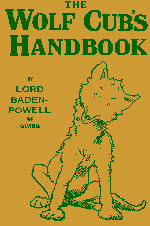
Wolf Cub's Handbook (written and illustrated by B-P) outlined everything any prospective Wolf Cub or Leader would want to know about the section, split up into Bites or chapters. These intermingled stories, skills, tests, games, activities and badge requirements in one continuous prose. This (with slight) modifications remained the handbook for the section for 50 years right up until the time of the Chief Scout's Advance Party Report of 1966, which radically changed the whole movement. Wolf Cub Leaders never did have their own handbook, like very early copies of Scouting for Boys, the Leader's hints were included in the boy's handbook.
 The basic tests for the Wolf Cubs changed very little over the years, although Baden-Powell was always aware that the Movement should change with the times, showing a credit to the badge scheme he instigated. Cubs first passing their Tenderpad requirements so they could be invested into the Cub Pack, then getting their First Star, which was placed on their cap so they had one eye open, and then working for their Second Star so they had both eyes open. Later B-P introduced the Leaping Wolf as a `link badge' between Cubs and Scouts, as one of the first attempts to stem the ever present problem of leakage between the two sections. It showed the other Scouts in the troop that irrespective of the length of time the Cub had been in the Pack, he was a good Cub, having completed his two stars and a number of proficiency badges. Initially there were twelve of these, rising to fifteen by the time of the Advance Party. Nowadays of course, in Australia, we have Bronze, Silver and Gold Boomerangs, with a Link Badge to Scouts.
As early as 1917, Wolf Cubs had their own monthly paper in the UK - The Wolf Cub, ten pages costing just one old pence, although it did double in price to 2d in 1920. This was also was the year which Cub Scouter training started at Gilwell in England.
Numbers in the section grew rapidly, in 1917 there were already 28,000 members, not a mean feat considering the official birthday of Wolf Cubbing was only 16th December 1916; and by the end of the 50's had reached nearly a quarter of a million.
Top

Rosanna Scout Group is a brand new Group, started in 2007, Scouting's Centenary year. The history of Scouts in Rosanna is something that we intend to research further and detail here. From what we know so far, at one point there were three Scout Groups in Rosanna, using both the 1st Rosanna and 2nd Rosanna Scout Halls:
* 1st Rosanna
* 2nd Rosanna
* 3rd Rosanna
* 1st/3rd Rosanna
The last of these closed some time ago, leaving the Scout Halls without a Group. The 1st Rosanna Hall was used for a while as the District Hall - a meeting place for the District's Leaders, plus a place to store some District equipment.
During 2006 a new Rover Crew was formed in Banyule District - Flinders Petrie was the name of a previously existing Crew, which was resurrected for the new one. The Rovers began meeting weekly in the 1st Rosanna Hall - each of the Rovers was a member of the Crew, but had ties back to their home Group, wherever that may be.
In February, 2007, our current Akela, Wayne, moved on from another Cub Pack and was asked to start a new Cub Pack - Rosanna Cub Scouts - forming the first Youth Section of the new Rosanna Scout Group - to primarily serve Rosanna and Heidelberg. The new Cub Pack started operation on Tuesday, 13th March, 2007.
Laura (Chil) who had been a Cub Scout Instructor at the same Pack as Wayne and was in the process of becoming a Leader, also moved across to Rosanna. Laura was also a Rover in the Flinders Petrie Rover Crew, and subsequently moved to the Lord Casey Rover Crew, with her Home Group being Rosanna. When she became too old for Rovers she focussed most of her Scouting activities on being a Leader at Rosanna. She had a stint as a Venturer Leader and then came back to Cubs. She's currently living in the UK for a couple of years - hopefully she'll come back as a Leader with us after that.
We've had a number of other Leaders help us over the years... David (Bagheera), Bryan (Rama) and Darren (Rahn).
Kerrie (Raksha) has sons in our Group, and another to come! She was invested on 18th September, 2012 and has been (and continues to be) a strong Leader in our Group.
With the strong numbers in Cubs, we need more Leaders. Cath (Rikki) and Neil (Bagheera) Gordon have recently stepped up and are going through the initial processes.
Wayne (Akela) has been a Cub Scout Leader since Feb 1999, having also been a Cub Instructor and Scout Leader in the past, and has obtained his Wood Beads, meaning that he's completed all of his Leader training. He has also trained as a Leader Trainer and as a Personal Leader Advisor.
Our Pack is very active and has taken part in activities such as Pack Holidays at such places as Pax Hill (Ballarat), Bay Park (Mt Martha), Eumeralla (Anglesea), Gilwell Park (Gembrook), Clifford Park (Wonga Park) and others. We take part in District Camps at places such as Clifford Park, Rowallan (Riddells Creek) and activities such as 'Big Camp' and Region Camp - a huge 4 day camp north of Whittlesea which is usually held every 3 years or so and which our Pack attended in November 2007 and again in 2013. Our Pack has also taken part in a number of Cuborees.
For quite a number of years now our numbers have been very strong - usually up around 32, and we consistently have a waiting list - we encourage parents waiting to try other Groups nearby in order to get their children in more quickly, but whether to do that or wait is of course up to them.
Our Group took its next step on the 5th of August, 2008, when with our first Cubs ready for Scouts, we started up our new Scout Troop. This added to the Cub Scouts and Rovers, becoming the third Youth Section in our Group and gave our Cubs the next step to move on to when they've completed their time with us. The Scouts initially met with Macleod Scout Troop, but on 6th May, 2009 our Scouts moved 'home' to Rosanna Scout Hall, under the leadership of Michelle Renfrew. Since then the Troop has gone from strength to strength (currently with 30+ Scouts and 8 Leaders) and is now, in turn, feeding into Venturers, with a new Unit to soon be established in the Group.
Top

Top
|
|